
Nevada
Return To Index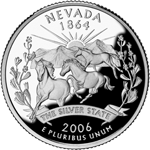
Issued Date: January 31, 2006
Description: Released on January 31, 2006, as the 36th coin in the 50 State Quarters Program, the Nevada quarter features three wild mustangs galloping before snow-capped mountains and a rising sun. Designed by Don Everhart, the coin also showcases sagebrush (the state flower) and a banner reading "The Silver State".
Key Details of the Nevada State Quarter:
Design Elements: Three wild horses (representing the freedom of the American spirit), a sunrise over mountains, and sagebrush.
Text Inscriptions: "Nevada," "1864" (year of statehood), and "The Silver State" (nickname).
Order: 36th state quarter.
Mint Locations: Philadelphia (P), Denver (D), and San Francisco (S - proof sets).
Composition: Copper-nickel clad (standard), or 90% silver/10% copper (proof).
Designers: John Flanagan (obverse) and Don Everhart (reverse).
The design was selected from several options and was intended to honor the state's natural beauty and its history as the "Silver State," a nickname derived from the 19th-century mining boom.
Description: Released on January 31, 2006, as the 36th coin in the 50 State Quarters Program, the Nevada quarter features three wild mustangs galloping before snow-capped mountains and a rising sun. Designed by Don Everhart, the coin also showcases sagebrush (the state flower) and a banner reading "The Silver State".
Key Details of the Nevada State Quarter:
Design Elements: Three wild horses (representing the freedom of the American spirit), a sunrise over mountains, and sagebrush.
Text Inscriptions: "Nevada," "1864" (year of statehood), and "The Silver State" (nickname).
Order: 36th state quarter.
Mint Locations: Philadelphia (P), Denver (D), and San Francisco (S - proof sets).
Composition: Copper-nickel clad (standard), or 90% silver/10% copper (proof).
Designers: John Flanagan (obverse) and Don Everhart (reverse).
The design was selected from several options and was intended to honor the state's natural beauty and its history as the "Silver State," a nickname derived from the 19th-century mining boom.