
Two Dollars
Return to Index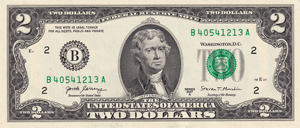
Portrait: Thomas Jefferson
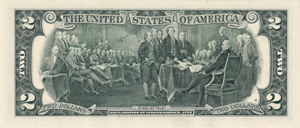
Reverse: Declaration of Independence
Drescription: The United States two-dollar bill is a, currently produced, legal tender note featuring a portrait of President Thomas Jefferson on the front (obverse) and an engraving of John Trumbull’s "Declaration of Independence" painting on the back (reverse). First issued in 1862, it was redesigned in 1976 for the Bicentennial to its current look, featuring green ink and a, usually, green Treasury seal.
Key Features and Design
Obverse (Front): A portrait of Thomas Jefferson, adopted in 1929 for the, small-sized, currency, and, often, a, red, blue, or green Treasury seal.
Reverse (Back): An engraving of the signing of the Declaration of Independence by Asher B. Durand, based on John Trumbull's painting.
Production and Usage
Active Status: Despite myths, the $2 bill is not discontinued; it is produced, periodically, by the Bureau of Engraving and Printing.
Scarcity in Circulation: While millions are printed, they are rarely used in daily transactions, leading to the false belief that they are rare or, especially, valuable.
Collectability: Most modern $2 bills (Series 1976–present) are worth exactly $2, though, older, notes or, unique, misprints can, sometimes, hold higher, collector value.
History and Myths
Origins: The first $2 note was issued in 1862 and featured Alexander Hamilton.
Myths: In the past, the note was associated with bad luck (a "deuce"), gambling, and, sometimes, political corruption (buying votes), leading some to tear off a corner to avoid misfortune.
Reverse: Declaration of Independence
Drescription: The United States two-dollar bill is a, currently produced, legal tender note featuring a portrait of President Thomas Jefferson on the front (obverse) and an engraving of John Trumbull’s "Declaration of Independence" painting on the back (reverse). First issued in 1862, it was redesigned in 1976 for the Bicentennial to its current look, featuring green ink and a, usually, green Treasury seal.
Key Features and Design
Obverse (Front): A portrait of Thomas Jefferson, adopted in 1929 for the, small-sized, currency, and, often, a, red, blue, or green Treasury seal.
Reverse (Back): An engraving of the signing of the Declaration of Independence by Asher B. Durand, based on John Trumbull's painting.
Production and Usage
Active Status: Despite myths, the $2 bill is not discontinued; it is produced, periodically, by the Bureau of Engraving and Printing.
Scarcity in Circulation: While millions are printed, they are rarely used in daily transactions, leading to the false belief that they are rare or, especially, valuable.
Collectability: Most modern $2 bills (Series 1976–present) are worth exactly $2, though, older, notes or, unique, misprints can, sometimes, hold higher, collector value.
History and Myths
Origins: The first $2 note was issued in 1862 and featured Alexander Hamilton.
Myths: In the past, the note was associated with bad luck (a "deuce"), gambling, and, sometimes, political corruption (buying votes), leading some to tear off a corner to avoid misfortune.