
One Dollar
Return to Index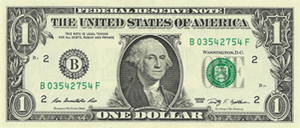
Portrait: George Washington
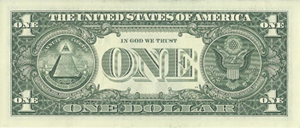
Reverse: Great Seal of the United States
Drescription: The United States one-dollar bill ($1) is the lowest denomination of U.S. paper currency, featuring a portrait of George Washington on the obverse and the Great Seal of the United States on the reverse. Issued in its current design since 1963, it is made of 75% cotton and 25% linen, measuring 6.14 by 2.61 inches. It remains the oldest, least-changed design in U.S. currency.
Key Features and Design Elements
Obverse (Front): Features a portrait of the first U.S. president, George Washington, based on a 1796 painting by Gilbert Stuart. It includes the Treasury Department seal, which shows a key and scales, representing security and fair measurement.
Reverse (Back): Displays both sides of the Great Seal of the United States. The left side features a pyramid, symbolizing strength and duration, topped with the "Eye of Providence". The right side features a bald eagle holding an olive branch (peace) and 13 arrows (war), representing the original 13 colonies.
Signage: "The United States of America" is printed at the top, and "One" or "1" appears in multiple locations.
Material and Feel: The note has a distinct texture, with raised printing. It is composed of a cotton-linen blend with embedded red and blue security fibers.
Symbolism and Security
The Number 13: The number 13 is prevalent, representing the original colonies—13 steps on the pyramid, 13 arrows, 13 olive leaves, and 13 stripes on the shield.
"In God We Trust": This phrase was added by law in 1955 and first appeared on paper money in 1957.
Security: Due to its low denomination, the $1 note is rarely counterfeited, allowing its design to remain consistent.
Signatures: The note bears the signatures of the Treasurer of the United States and the Secretary of the Treasury.
All U.S. currency, including older versions of the one-dollar bill, remains legal tender.
Reverse: Great Seal of the United States
Drescription: The United States one-dollar bill ($1) is the lowest denomination of U.S. paper currency, featuring a portrait of George Washington on the obverse and the Great Seal of the United States on the reverse. Issued in its current design since 1963, it is made of 75% cotton and 25% linen, measuring 6.14 by 2.61 inches. It remains the oldest, least-changed design in U.S. currency.
Key Features and Design Elements
Obverse (Front): Features a portrait of the first U.S. president, George Washington, based on a 1796 painting by Gilbert Stuart. It includes the Treasury Department seal, which shows a key and scales, representing security and fair measurement.
Reverse (Back): Displays both sides of the Great Seal of the United States. The left side features a pyramid, symbolizing strength and duration, topped with the "Eye of Providence". The right side features a bald eagle holding an olive branch (peace) and 13 arrows (war), representing the original 13 colonies.
Signage: "The United States of America" is printed at the top, and "One" or "1" appears in multiple locations.
Material and Feel: The note has a distinct texture, with raised printing. It is composed of a cotton-linen blend with embedded red and blue security fibers.
Symbolism and Security
The Number 13: The number 13 is prevalent, representing the original colonies—13 steps on the pyramid, 13 arrows, 13 olive leaves, and 13 stripes on the shield.
"In God We Trust": This phrase was added by law in 1955 and first appeared on paper money in 1957.
Security: Due to its low denomination, the $1 note is rarely counterfeited, allowing its design to remain consistent.
Signatures: The note bears the signatures of the Treasurer of the United States and the Secretary of the Treasury.
All U.S. currency, including older versions of the one-dollar bill, remains legal tender.