

Five Hundred Dollar Note
Return to Index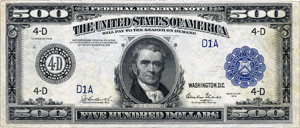
Portrait: John Marshall
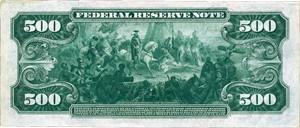
Drescription: The 1918 $500 Federal Reserve Note is a rare, large-size ("horse-blanket") banknote. It features a portrait of Chief Justice John Marshall on the front and a vignette of "De Soto Discovering the Mississippi" on the back. These blue-sealed notes were used for inter-bank transfers.
Key Features and Description:
Obverse (Front): Features a portrait of John Marshall, the fourth Chief Justice of the United States. The notes were issued under the Federal Reserve Act of December 23, 1913, as amended in 1918.
Reverse (Back): Displays an engraving titled "De Soto Discovering the Mississippi," symbolizing exploration.
Appearance: Known as a "large-size" note, and often feature a blue treasury seal.
Signatures: Often signed by the Treasurer of the United States and the Secretary of the Treasury, such as Burke and Glass.
Significance: These notes were not used in daily commerce but for large-scale transactions and transfers between Federal Reserve banks.
Rarity: They are highly collectible and rare, often referred to in numismatic circles as high-value, early 20th-century currency.
Drescription: The 1918 $500 Federal Reserve Note is a rare, large-size ("horse-blanket") banknote. It features a portrait of Chief Justice John Marshall on the front and a vignette of "De Soto Discovering the Mississippi" on the back. These blue-sealed notes were used for inter-bank transfers.
Key Features and Description:
Obverse (Front): Features a portrait of John Marshall, the fourth Chief Justice of the United States. The notes were issued under the Federal Reserve Act of December 23, 1913, as amended in 1918.
Reverse (Back): Displays an engraving titled "De Soto Discovering the Mississippi," symbolizing exploration.
Appearance: Known as a "large-size" note, and often feature a blue treasury seal.
Signatures: Often signed by the Treasurer of the United States and the Secretary of the Treasury, such as Burke and Glass.
Significance: These notes were not used in daily commerce but for large-scale transactions and transfers between Federal Reserve banks.
Rarity: They are highly collectible and rare, often referred to in numismatic circles as high-value, early 20th-century currency.