
One Dollar Note
Return to Index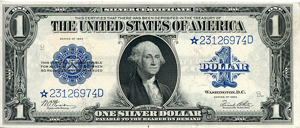
Portrait: George Washington
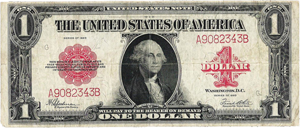
Drescription: The 1923 United States $1 banknote, often called a "horse blanket," is a large-size note (approx. 7.375 x 3.125 inches) featuring George Washington on the obverse and an ornate reverse. These were the final large-size $1 bills, issued as both blue-sealed Silver Certificates and red-sealed United States Notes.
Key Features of the 1923 $1 Banknote:
Design: Both the 1923 $1 Silver Certificate and $1 United States Note feature an identical obverse portrait of George Washington, with differences in seal color and text obligations.
"Horse Blanket": The notes are roughly 35% to 50% larger than modern currency.
Obverse (Front): Features a central portrait of George Washington, with blue (Silver Certificate) or red (US Note) serial numbers and Treasury seals. The text includes "THE UNITED STATES OF AMERICA" and "ONE DOLLAR".
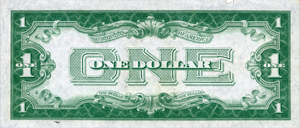
Reverse (Back): Ornate, detailed engraving with "THE UNITED STATES OF AMERICA" and a large "ONE" or "1" in the center.
Signatures: Various, depending on the specific series (e.g., Speelman/White or White/Mellon).
Types:
Silver Certificate (Blue Seal): Backed by silver coin held in the Treasury.
United States Note (Red Seal): Legal tender, backed by government credit.
Significance: These marked the end of the large-size note era, replaced by smaller-sized currency in 1928.
Additionally, a rare 1923 $5 Silver Certificate, known as the "Porthole" note, features a portrait of Lincoln in a large circle.
Drescription: The 1923 United States $1 banknote, often called a "horse blanket," is a large-size note (approx. 7.375 x 3.125 inches) featuring George Washington on the obverse and an ornate reverse. These were the final large-size $1 bills, issued as both blue-sealed Silver Certificates and red-sealed United States Notes.
Key Features of the 1923 $1 Banknote:
Design: Both the 1923 $1 Silver Certificate and $1 United States Note feature an identical obverse portrait of George Washington, with differences in seal color and text obligations.
"Horse Blanket": The notes are roughly 35% to 50% larger than modern currency.
Obverse (Front): Features a central portrait of George Washington, with blue (Silver Certificate) or red (US Note) serial numbers and Treasury seals. The text includes "THE UNITED STATES OF AMERICA" and "ONE DOLLAR".
Reverse (Back): Ornate, detailed engraving with "THE UNITED STATES OF AMERICA" and a large "ONE" or "1" in the center.
Signatures: Various, depending on the specific series (e.g., Speelman/White or White/Mellon).
Types:
Silver Certificate (Blue Seal): Backed by silver coin held in the Treasury.
United States Note (Red Seal): Legal tender, backed by government credit.
Significance: These marked the end of the large-size note era, replaced by smaller-sized currency in 1928.
Additionally, a rare 1923 $5 Silver Certificate, known as the "Porthole" note, features a portrait of Lincoln in a large circle.