
Washington Quarter 1932-1998
Return To Index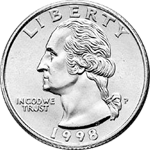
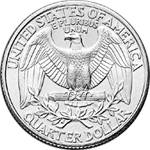
Drescription: The Washington Quarter (1932–1998) features a left-facing bust of George Washington by John Flanagan on the obverse and a perched eagle on the reverse. Struck in 90% silver through 1964, it transitioned to a copper-nickel clad composition in 1965. A special Bicentennial design (1975–1976) featured a drummer boy, while 1932–1998 coins typically show an eagle, arrows, and olive branches.
Key Design and Specifications (1932–1998)
Obverse: George Washington portrait facing left, with "LIBERTY" above, "IN GOD WE TRUST" in the left field, and the date at the bottom.
Reverse: A heraldic eagle with wings spread, perched on a bundle of arrows, flanked by two olive branches. "UNITED STATES OF AMERICA" is at the top, "E PLURIBUS UNUM" above the eagle, and "QUARTER DOLLAR" at the bottom.
Composition: 90% silver, 10% copper (1932–1964); copper-nickel clad (1965–1998).
Designer: John Flanagan.
Mint Marks: Located on the reverse below the wreath (pre-1964) or to the right of the ribbon (1968–1998).
Significant Variations
1932-D & 1932-S: Considered key dates for the series with low mintages (436,800 and 408,000 respectively).
1975-1976 Bicentennial: Features a dual date "1776-1976" and a colonial drummer boy on the reverse.
1965–1967: No mint marks were used during these years.
Key Design and Specifications (1932–1998)
Obverse: George Washington portrait facing left, with "LIBERTY" above, "IN GOD WE TRUST" in the left field, and the date at the bottom.
Reverse: A heraldic eagle with wings spread, perched on a bundle of arrows, flanked by two olive branches. "UNITED STATES OF AMERICA" is at the top, "E PLURIBUS UNUM" above the eagle, and "QUARTER DOLLAR" at the bottom.
Composition: 90% silver, 10% copper (1932–1964); copper-nickel clad (1965–1998).
Designer: John Flanagan.
Mint Marks: Located on the reverse below the wreath (pre-1964) or to the right of the ribbon (1968–1998).
Significant Variations
1932-D & 1932-S: Considered key dates for the series with low mintages (436,800 and 408,000 respectively).
1975-1976 Bicentennial: Features a dual date "1776-1976" and a colonial drummer boy on the reverse.
1965–1967: No mint marks were used during these years.