
Sacagawea Dollar (2000-2008)
Return To Index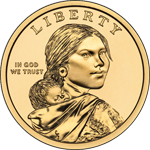
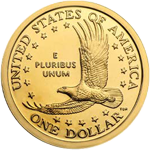
Drescription: The Sacagawea Golden Dollar, minted by the U.S. Mint from 2000–2008, features a distinctive golden color (88.5% copper, 6% zinc, 3.5% manganese, 2% nickel) and a 26.5 mm diameter. The obverse, designed by Glenna Goodacre, depicts the Shoshone guide Sacagawea with her infant son, Jean-Baptiste, on her back. The original reverse (2000–2008) features a soaring eagle, which shifted to annual, thematic Native American cultural designs starting in 2009.
Key Details:
Design (Obverse): Portrait of Sacagawea, modeled by Randy'L He-dow Teton, representing Shoshone history.
Design (Reverse 2000–2008): A soaring eagle designed by Thomas D. Rogers, symbolizing freedom and peace.
Edge: Plain (no lettering), with a weight of 8.1 grams.
Composition: Copper core clad with manganese brass, providing the "golden" color.
Significance: It was the first U.S. dollar coin to feature a Native American woman and was intended to replace the Susan B. Anthony dollar.
Key Varieties: The 2000-P "Cheerios" dollar (high value) and the "Wounded Eagle" (die error) are notable for collectors.
Key Details:
Design (Obverse): Portrait of Sacagawea, modeled by Randy'L He-dow Teton, representing Shoshone history.
Design (Reverse 2000–2008): A soaring eagle designed by Thomas D. Rogers, symbolizing freedom and peace.
Edge: Plain (no lettering), with a weight of 8.1 grams.
Composition: Copper core clad with manganese brass, providing the "golden" color.
Significance: It was the first U.S. dollar coin to feature a Native American woman and was intended to replace the Susan B. Anthony dollar.
Key Varieties: The 2000-P "Cheerios" dollar (high value) and the "Wounded Eagle" (die error) are notable for collectors.